

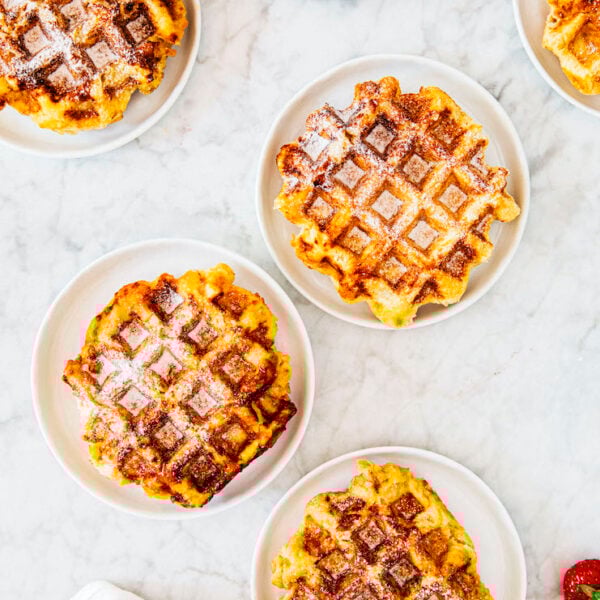
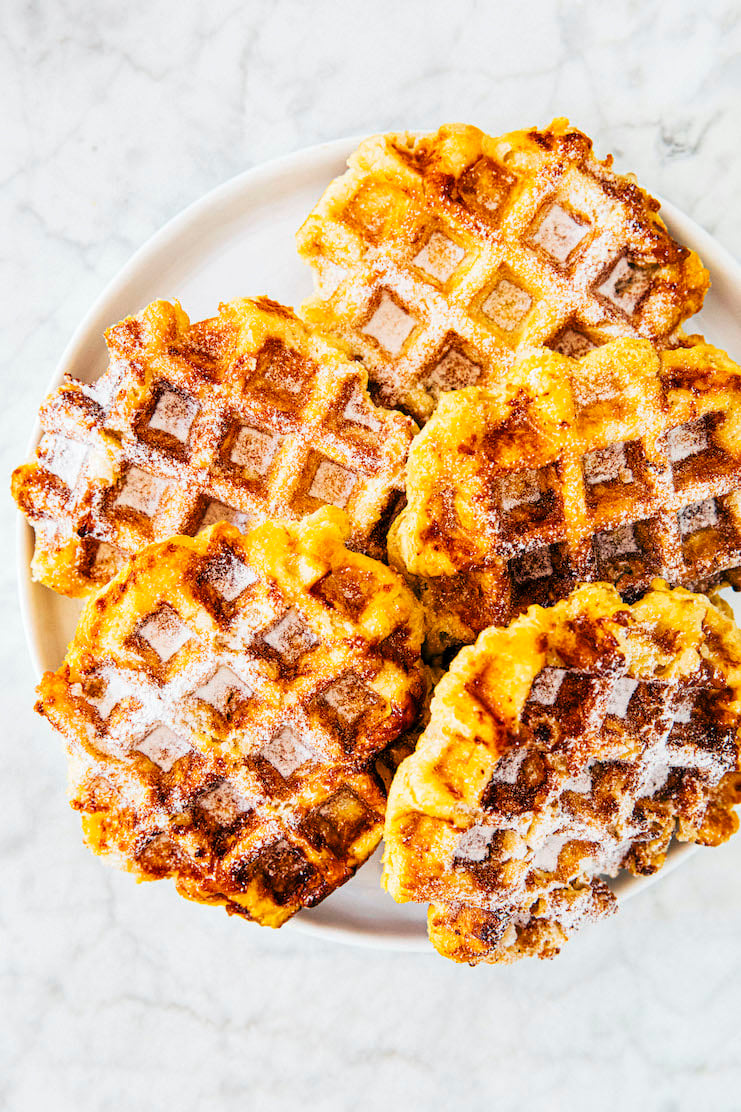
About Liège Waffles
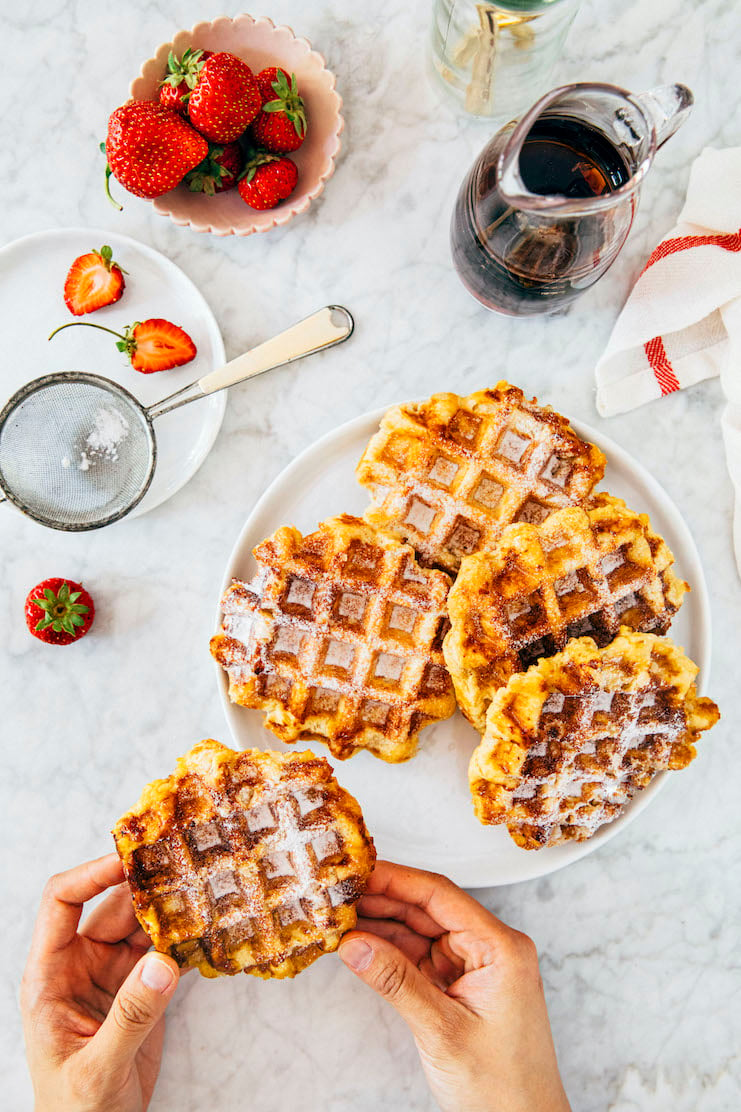
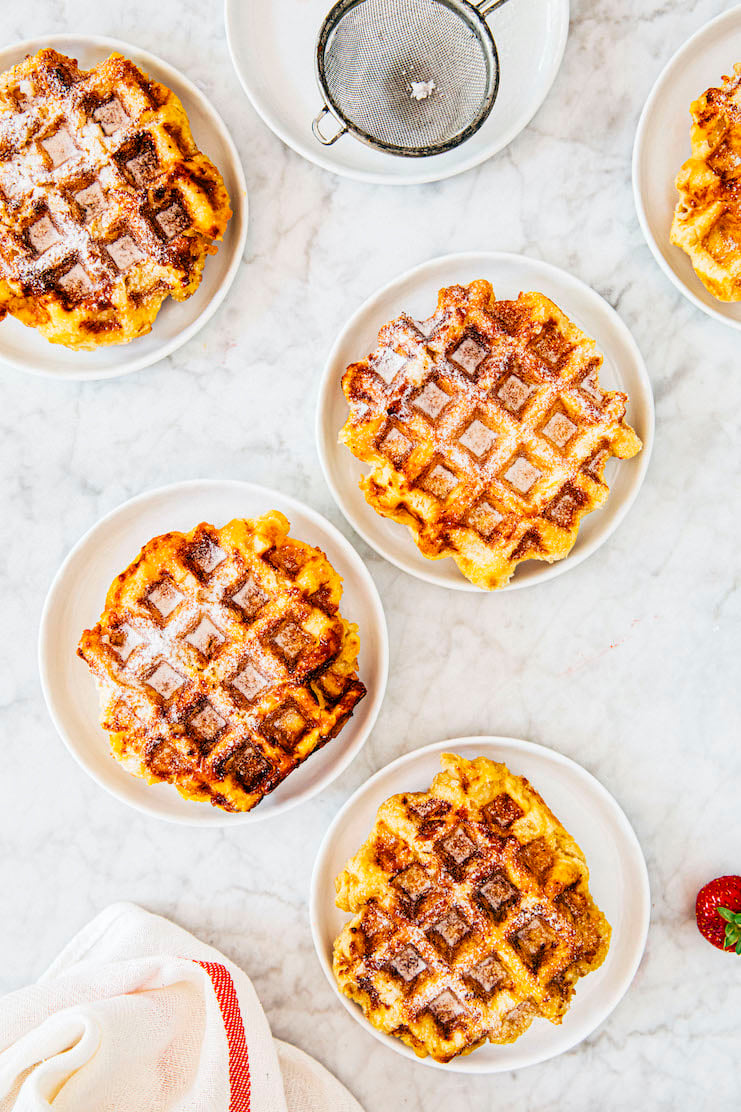
Liège waffles are made from a yeasted, sweet brioche dough studded with large, craggy sugar cubes known as Belgian pearl sugar. The waffles are breadier than regular waffles, with a texture and flavor similar to toasted brioche.
But the real star of the show is the Belgian pearl sugar. If cooked when buried within the batter, the pearl sugar melts, giving the waffle delicious, molten flavor. BUT if the pearl sugar happens to be on the outside of the waffle batter, the sugar turns crunchy and caramelizes. A bite tastes like a combination of buttery brioche and crème brulée.
For more delicious and unique breakfast recipes on Hummingbird High, check out my Breakfast Recipe collection! Popular recipes include My Best Dutch Baby Pancake Recipe, Malasadas (Hawaiian Donuts), and these Copycat Levain Bakery Blueberry Muffins.
What’s the difference between a Liège waffle and a Belgian waffle?
In Belgium, there are two types of waffles: the Liège waffle and the Brussels waffle.
The Brussels waffle is more commonly known as the “Belgian waffle.” Although Brussels waffles were traditionally made from a yeasted dough like Liège waffles, they are now typically made from cake batter. This cake batter uses baking powder or soda as its leavener, resulting in light and crispy waffles. The Brussels waffle is very similar to the Belgian waffles you find on breakfast menus in the United States.
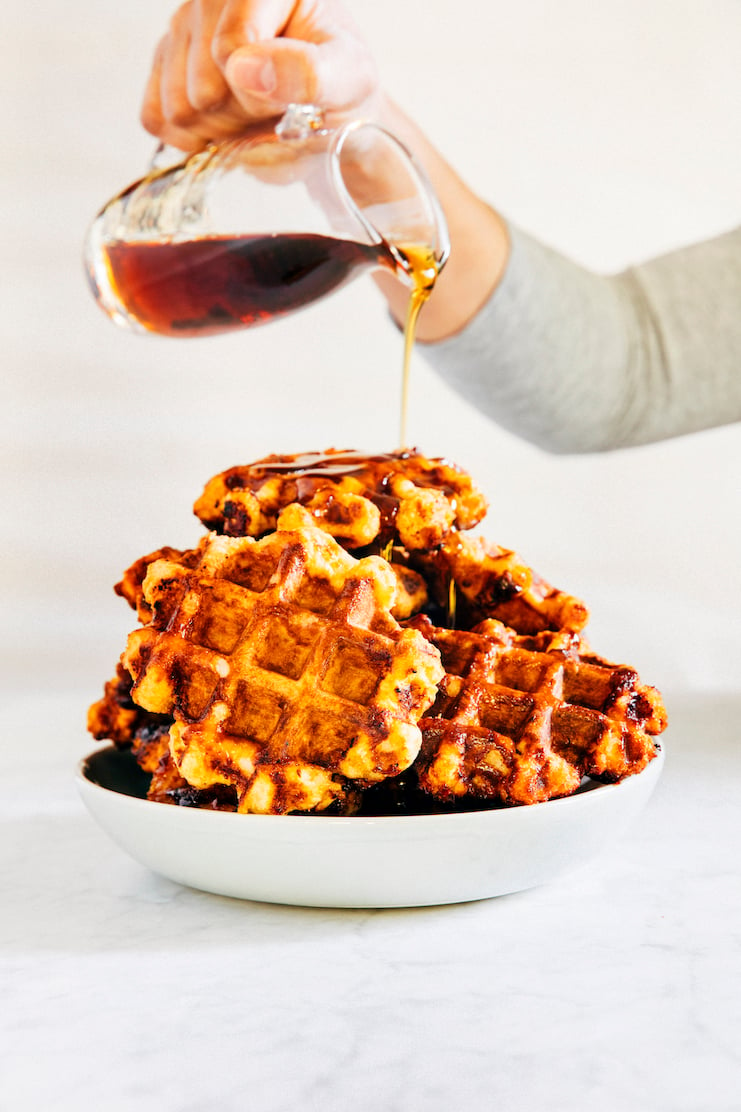
A Note About The Liège Waffles Recipe In My Cookbook
The Liège waffles recipe below is from my cookbook, Weeknight Baking. However, the recipe contains a misprint. Specifically, after making the Liège waffles dough, the recipe instructs you to turn the dough out onto the kitchen counter and knead it into a ball. The recipe then instructs you to proof the dough overnight.
But Liège waffle dough actually has a texture and consistency more similar to batter than dough. So if you own a copy of my cookbook, I recommend ignoring that instruction and following the recipe below instead. Although you can technically follow the book’s instructions, it’s messy and inconsistent. You’ll need to add a LOT of flour in order to knead the dough. You get much better results if you simply let the dough proof overnight without kneading it. The Liège waffle dough will turn into a more traditional, knead-able dough after an overnight proof in the fridge.
I sincerely apologize to anybody who followed the recipe’s instructions and were either confused or disheartened by the results. I hope to fix this misprint in the next edition of my book!
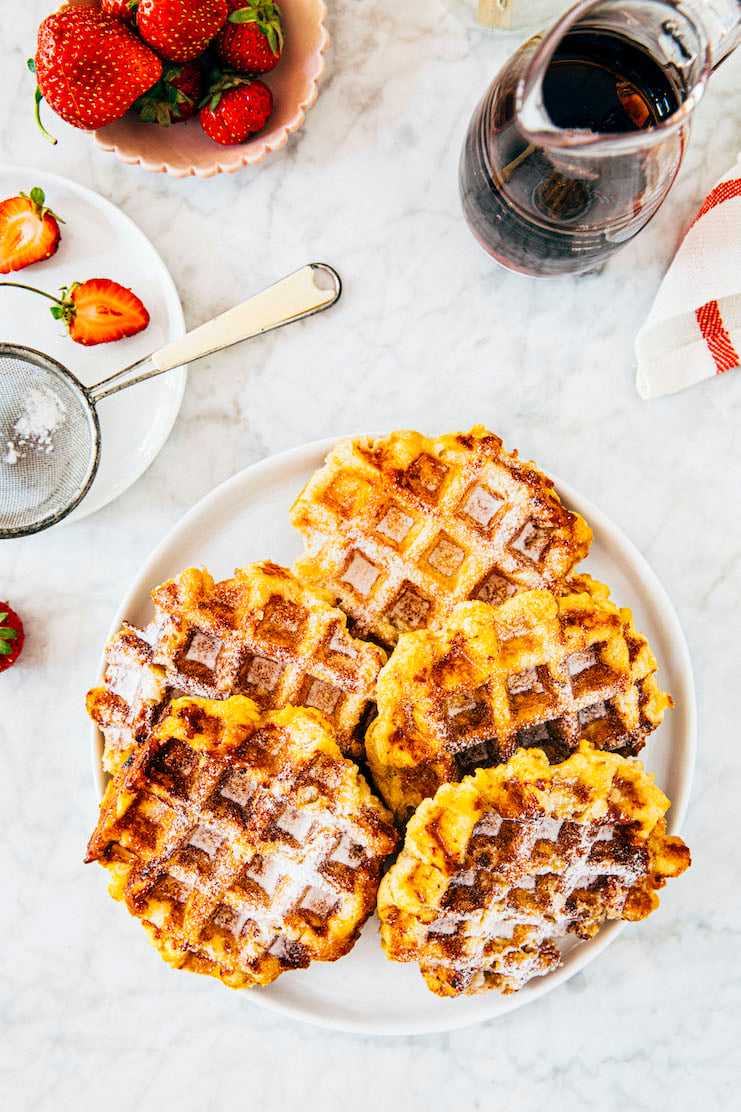
Ingredients and Substitutions
Now that I’ve convinced you to make Liège waffles, let’s talk about some of its key ingredients and their substitutions:
- Brown Sugar. Brown sugar is available in two varieties: light or dark. Dark brown sugar is my personal preference; because it contains more molasses, I find it to be more flavorful. However, you can use either in this liège waffles recipe without altering its flavor too much.
- Instant Yeast. In a pinch, you can use active dry yeast instead. However, you’ll need to change the way you activate it and mix it into the dough.
- Kosher Salt. Kosher salt is the best salt for baking recipes. But if you don’t have any, use table salt. Just use half the amount listed in the recipe.
- Belgian Pearl Sugar. Belgian pearl sugar is the signature ingredient of Liège waffles. The pearl sugar looks like small, white pebbles (but made out of sugar instead of stone, obviously). I’ve also seen other folks describe Belgian pearl sugar as similar to crushed, irregular sugar cubes. Either way, these pearl sugar pebbles melt and caramelize in the waffle dough, giving Liège waffles their molten appearance and signature crunch.
Back when I first posted this recipe, you could only get Belgian pearl sugar online at Amazon, and occasionally at fancy grocery stores like Whole Foods Market and specialty cooking shops like Sur La Table. However, in the last few years, I’ve seen Belgian pearl sugar sold at QFC, Walmart and online grocery shopping services like Instacart. Pretty cool, right?
Wait, is Belgian pearl sugar the same thing as Swedish pearl sugar?
NO! Belgian pearl sugar looks like pebbles. However, Swedish pearl sugar is much smaller—it looks more like pretzel salt! Using Swedish pearl sugar in this Liège waffles recipe (or any Liège waffle recipe, really) will NOT produce the right results.
Can you substitute Belgian pearl sugar with something else in this Liège waffle recipe?
No, please don’t. Like I said before—Belgian pearl sugar is the signature ingredient of Liège waffles. Without it, you’ll just be making regular ol’ yeasted Belgian waffles.
Recipe Troubleshooting and FAQ
Help! My dough came out super thin. It looks more like brownie or pancake batter than brioche dough. What did I do wrong?
Absolutely nothing! When developing the Liège waffle recipe for my cookbook, Weeknight Baking, I made six different Liège waffle recipes and taste-tested them side-by-side. One was a traditional Belgian recipe from an old European cookbook; the other was the Liège waffle recipe in the Lars Own Belgian pearl sugar package. Others were gleaned from more modern cookbooks and trusted food blogs and magazines. But all had one thing in common: the recipes made a thin, batter-like dough. Based on my research (short of actually heading to Liège and spying on famed waffle makers), I think this is what traditional Liège waffle dough is like!
And don’t worry! The dough firms up as it cools. After about an hour or so at room temperature, it will start to look and feel more like a sticky brioche dough. The effect is magnified the longer it sits. In the recipe below, I instruct you to refrigerate the dough and let it rise overnight. In the morning, you’ll be greeted with a dough that looks and feels more like traditional brioche dough. You’ll be able to pick it up, roll it into a ball, and knead the Belgian pearl sugar by hand then.
Do I really have to proof the dough for these Liège waffles overnight? Or can I make this Liege waffle recipe all in one day instead?
If you insist, you technically can make the Liège waffles all in one day. After making the dough, instead of refrigerating, let sit in a warm spot until doubled in size, about 1 to 2 hours. Then, follow the recipe’s instructions for mixing in the Belgian pearl sugar and cooking the waffles.
That being said, I don’t recommend making the Liège waffles all in one day. Why? Between you and me, Liège waffle dough can be finnicky. If it’s a super hot day, the butter has a tendency to separate from the dough. And regardless of the day’s temperature, the dough will be harder to measure and scoop into the waffle iron. It will be too sticky and gloopy without the overnight chill in the fridge.
Additionally, the overnight rise in the fridge allows the dough to develop the complex, yeasty flavors you know and love from bread. It’s worth it, I promise.
Best Recipe Tips
About Ingredients
- The Liège waffle dough requires 1 ½ Tablespoons of brown sugar. Unfortunately, a 1 ½-Tablespoon measure isn’t typically available with most measuring spoon sets. However, you can use a ½-teaspoon and 1-teaspoon measure to measure out the equivalent of 1 ½ Tablespoons. Specifically, 1 ½ Tablespoons equals 4 ½ teaspoons. You can also buy a 1 ½ Tablespoon measure on Amazon. Learn more in my Best Small Batch Baking Tools guide!
- Pay attention to the ingredients and the temperatures they’re listed at in the recipe. Yeast is a living thing and you can easily kill it by mixing it with water and butter that’s too hot. You want the temperature of these ingredients to be similar to that of a warm bath and no more. And be sure to use eggs that are at room temperature rather than straight from the fridge! Eggs straight from the fridge will be too cold and will lower the temperature of the overall mixture, risking dropping it to a point where the yeast won’t activate properly.
Use A Paddle Attachment
- The recipe below also instructs you to make the Liège waffle dough in a stand mixer fitted with the paddle attachment. Traditionally, yeasted recipes instruct bakers to use the dough hook attachment. However, because Liège waffle dough is thin like a batter, I recommend using the paddle attachment instead.
How To Measure Out The Waffles
- The yield of this recipe will vary based on how much dough it will take to make a single waffle in your waffle iron. I mentioned earlier that I used this Breville Smart Pro 2 Slice Waffle Maker. It takes a whopping ½ cup of batter/dough to make a single waffle! However, in Weeknight Baking, I used a 4-Tablespoon cookie dough scoop to make 12 waffles with this recipe. This time around, I used 8 Tablespoons of waffle dough (scooped with 2 portions from the 4-Tablespoon cookie dough scoop) to make 6 thicker waffles.
Best Cooking Tip
- When making the first batch of waffles, I lightly coat my waffle press with cooking spray. However, these Liège waffles don’t really need it. They are so buttery that they leech a lot of butter out into the press as they cook, making them self-greasing (lol). So don’t worry if you see that happening—it’s totally normal, I promise!
Video Tutorial
Use the video player below to watch my Instagram Story tutorial on how to make this liège waffle recipe! The arrows to the left and right of the frame allow you to skip through the different recipe steps. You can also hit the “pause” or “enlarge” buttons on the upper right hand side of the frame to pause or enlarge the frames accordingly.
Alternatively, head to my Instagram profile to watch these Stories on mobile! The circles underneath my bio indicate saved Instagram Story highlights depicting various recipes. Clicking on one of the circles will play the videos you see above. You may need to scroll right to find this liège waffle recipe.

Get the Recipe: Liège Waffles Recipe
Ingredients
For the Liège Waffles:
- 2 cups (9 ounces or 255 grams) all-purpose flour
- 1 ½ Tablespoons tightly packed dark OR light brown sugar
- 1 ¾ teaspoons instant yeast
- ¾ teaspoon kosher salt
- ⅓ cup (2.65 ounces or 75 grams) water, warmed to between 120° and 130°F
- 3 large eggs, at room temperature
- 1 cup (8 ounces or 227 grams) unsalted butter, melted and warmed to between 120° and 130°F
- 1 teaspoon pure vanilla extract
- 1 cup (5.5 ounces or 156 grams) Belgian pearl sugar
Equipment
- a waffle iron
Instructions
Day 1: Make the Dough
- First, make the waffle dough. In the bowl of a stand mixer fitted with the paddle attachment, combine the flour, brown sugar, yeast, and salt. Beat on low until just combined. Slowly pour in the water and beat until a shaggy dough forms, about 1 minute. Add the eggs, one at a time, adding the next egg only after the previous one has been fully incorporated, using a rubber spatula to scrape down the bottom and sides of the bowl after each addition. With the mixer on low, slowly pour in the melted butter and vanilla and beat for 1 minute, then increase the mixer to medium and beat for 2 to 3 minutes more, or until no more butter is pooling at the bottom of the bowl. The dough will be sticky, thick, and a little lumpy. It will look more like pancake batter at this point, but that's totally okay, I promise!
- Refrigerate overnight. Cover the bowl with plastic wrap. Refrigerate overnight.
Day 2: Make the Waffles
- Prep your oven and waffle iron. Preheat the oven to 250°F. Preheat a waffle iron according to the manufacturers' instructions and lightly coat each waffle plate with cooking spray.
- Uncover the dough and discard the plastic wrap. Use a rubber spatula to mix in the pearl sugar.
- Cook the waffles. Divide the dough and cook the waffles according to the manufacturer's instructions until crisp and golden brown, coating the waffle plates with cooking spray between batches as needed.
- Serve and store. Serve immediately, or place the finished waffles directly on the oven rack to keep them warm and crisp until ready to serve.
Notes
Can you freeze Liège waffles?
Yes! In fact, cooked Liège waffles freeze beautifully. Place any leftover waffles in a large zip-top bag and freeze for up to 3 months. To serve, toast in a traditional toaster or toaster oven—there’s no need to let the waffles thaw beforehand! However, you may need to toast them for longer than you would room-temperature bread.get new recipes via email:
buy the book
Weeknight Baking:
Recipes to Fit your Schedule
Over the past several years of running Hummingbird High, I kept a crucial aspect of my life hidden from my readers: I had a full-time, extremely demanding job in the tech world. In my debut cookbook, Weeknight Baking, I finally reveal the secrets to baking delicious desserts on a tight schedule.

These look like the best breakfast ever! I wonder if they'd be good if you cool them and dip them in chocolate for dessert 🙂 yum.
Your description has my mouth watering! I've never had a Liege waffle, but I'm pinning this recipe to try. Thanks for sharing!
Oh dear those look amazing. I'm making waffles tomorrow for breakfast… but, lord knows I don't have the patience to wait for two hours to have them rise properly. That one is going to have to wait for a special occasion… or maybe breakfast as dinner!
Liege waffles are one of my absolute faves – there's nothing better than those crunchy bites of sugar and the buttery rich dough. I definitely need to buy a waffle maker…
These waffles look wonderful!!!
These look absolutely amazing. I love waffles…I need to make these on a Saturday morning sometime as a special treat.
xxx
Jaclyn
http://www.loveandbellinis.com
would the rock sugar (rock salt size granules) from Wilton's work? It is probably the same cost, but it can be found at JoAnns.
Rock sugar from Wilton would work, but it won't be as authentic as the liege waffles. Instead, I recommend using sugar cubes, giving them a quick grind in a food processor (or, if you don't have a food processor, stick them in a zip lock bag and use a rolling pin to give them a few good whacks) to break them up.
This looks amaaaazing! 🙂
http://cafecraftea.blogspot.com
I did everything as you suggested, right down to the pear sugar (thank you Amazon!) and these were so delicious we couldn’t stand it. My most favorite waffle ever! Thank you!
I made a batch of these liege waffles the second you posted the recipe and they turned out perfect. I didn’t proof over night, but 6 hours in the fridge worked for me. Crisp buttery waffles with an amazing crunch, courtesy of the pearl sugar. I wish I doubled this recipe as I only have a few to freeze for later. Thank you for a wonderful recipe!
So I’m making these now. I use an All Clad waffle maker. It’s nonstick and has never had recipes stick to my. How do I clean off all this melted sugar? I hope I didn’t just destroy my waffle iron!
Hi! Don’t panic—the next time you make a batch of waffles, you can use a “sacrificial” waffle and cook it in the iron without cleaning it. Once the waffle finishes cooking and you lift out the waffle, it should take all the gunk with it.
If you want to be more proactive, heat up the waffle iron (it’s easier to clean while it’s hot, but be SUPER careful). Once it’s hot, turn it off and wipe it down with a paper towel. To get the paper towel between the crevices/cavities, you can use a fork or a chopstick and kind of wipe it down that way. That’ll help prevent you from burning yourself!
I just made these for breakfast. Made the dough last night and put it in the fridge, like instructed. To tell you the truth I was very sceptical, but boy oh boy, the turn out great! So crispy on the outside and layered on the inside, kinda like croissant. I don’t know how am I going to eat other waffles from now on.
Thank you very much ❤️!
The waffles are delicious, I always used another recipe sent by my Belgian friend, but decided to search for a better one.
There are pools of butter that drip from my waffle iron, when I flip my iron and in my waffle iron, am I doing something wrong?
Hi Michelle, thank you so much for such a wonderful blog and book. In the book you say to tip out the dough in a lightly floured counter but the dough is super runny, I did it but had to add like half a cup of flour to the batter, so my question is we should just leave it in the bowl? And not tip it out? Thank you!
Hi! Great question—I actually talk about it in this blog post, but the recipe in my book has a typo. This is the correct version! And here’s the note about it:
“A Note About The Liège Waffles Recipe In My Cookbook
The Liège waffles recipe below is from my cookbook, Weeknight Baking. However, the recipe contains a misprint. Specifically, after making the Liège waffles dough, the recipe instructs you to turn the dough out onto the kitchen counter and knead it into a ball. The recipe then instructs you to proof the dough overnight.
But Liège waffle dough actually has a texture and consistency more similar to batter than dough. So if you own a copy of my cookbook, I recommend ignoring that instruction and following the recipe below instead. Although you can technically follow the book’s instructions, it’s messy and inconsistent. You’ll need to add a LOT of flour in order to knead the dough. You get much better results if you simply let the dough proof overnight without kneading it. The Liège waffle dough will turn into a more traditional, knead-able dough after an overnight proof in the fridge.
I sincerely apologize to anybody who followed the recipe’s instructions and were either confused or disheartened by the results. I hope to fix this misprint in the next edition of my book.”
To my knowledge, the Breville waffle iron makes American style waffles. Have you tried these in a Belgium style iron? If so any significant difference?
Disclaimer I’ve never been to Belgium and had Liège waffles there but these were delicious!! Super simple to come together and not too heavy or too sweet. I have a “NordicWare Belgian waffler” which you use on the stove so it’s easy to control the temperature and done-ness. These came out perfect. Definitely a recipe I’d make again.
Thank you Michelle. After a trip to Belgium this spring, I have been on a quest to recreate these delicious crunchy, light and pillowy bits of heaven. Your recipe was attempt number 5!
Since I know my family does not prefer the more complex flavors which develop in an overnight rest, the batter rested in the fridge for just a couple of hours. I made the batter before I started preparing dinner. After dinner, I removed the batter from the fridge and made these for dessert. Amazing!
A nod to The Pancake Princess who lead me to you!
These are so delicious. I had a liege waffle at a restaurant & have been trying to find the right recipe & these are the best by far. I have a question about the waffle iron, as it turned out I have this same waffle iron but the sugar that caramelized in the maker was difficult to get remove. I got a lot out but I’m waiting for it to cool completely to see if I can get the rest out. Is there a special trick to get the waffle maker cleaned completely? Should I turn down the heat so it doesn’t get as carmelized?
Great question! Unfortunately this waffle recipe makes the iron really hard to clean—it’s the nature of the liege sugar. I do have a couple of tips. First: it’s easier to clean right after making the waffles while the iron is still hot. I take a paper towel and a chopstick and use the chopstick to get the paper towel around the crevices of the iron, trying to soak up as much of the grease and sticky stuff as I can. Watch out though, it’s easy to burn yourself while doing this!
My second tip is to wait until the iron is completely cooled, then make a regular batch of waffles with Bisquick or other waffle mix. I make a “sacrifice” waffle that nobody eats that then picks up any of the leftover grub.
You can also find waffle irons with removable plates that are dishwasher friendly. I like this one: https://amzn.to/4iN7iDF
I’ve been fortunate to walk the streets of Liège in cold damp, misty mornings, with les hot gaufres in two hands. I’ve attempted to recreate that crispy, sweet and yeasty flavor for a long time. It’s unfortunate that Americans think the “Belgian” waffles they eat at IHop are what they expect from Liège Gaufres (then again, what can they expect.)
I’ve attempted the recipes suggested by the Pancake Princess, and I pretty much agree with her final choices… which include this one at the top.
I needed to have faith in your observation about your “dough” being a little like regular pancake or waffle batter, and that in the end, it would turn out alright… cuz it did…
Thanks again… it was a treat
Rrce
P.S. Just an after thought about others’ comments, with all the butter in the recipe, how can anything be sticking to non-stick waffle plates?