

How to Grease A Bundt Cake Pan To Prevent Sticking
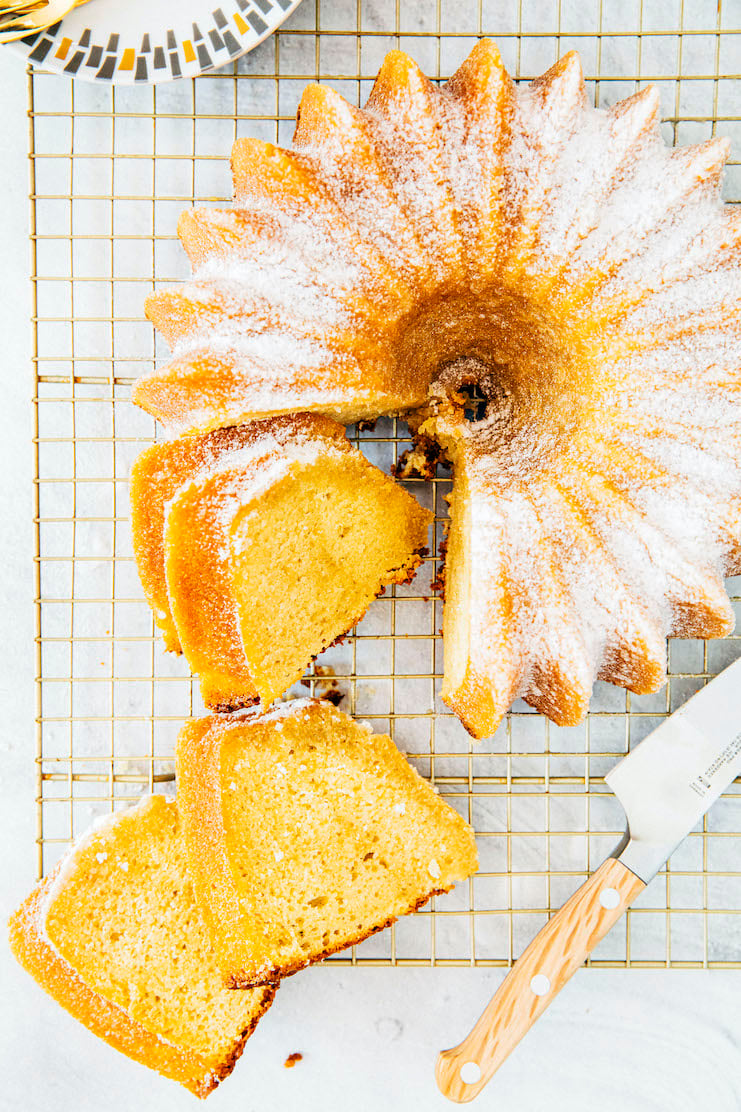
All My Best Tips On How to Make Sure Your Bundt Cake Doesn’t Stick
If you’ve ever asked, “Why does my bundt cake stick to the pan?”, this post is for you! This guide walks you through exactly how to prevent stuck cakes, even with detailed, craggy bundt cake designs.
Drawing on years of recipe testing, I break down the most reliable methods bakers actually use. Check them out below:
1. Use the right kind of bundt pan.
Look for a bundt pan whose interior is coated with a non-stick surface. If you’re not confident in your bundt cake making abilities yet, stick with a bundt pan design that doesn’t have as many nooks, crannies, and sharp edges. All those sharp edges will make it harder to grease and turn out the cake. I recommend this Nordic Ware bundt pan for beginners.
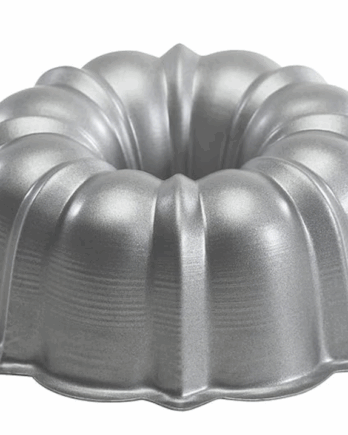
Nordic Ware ProForm Bundt Pan
2. Use lots of cooking spray. Like, an uncomfortable amount.
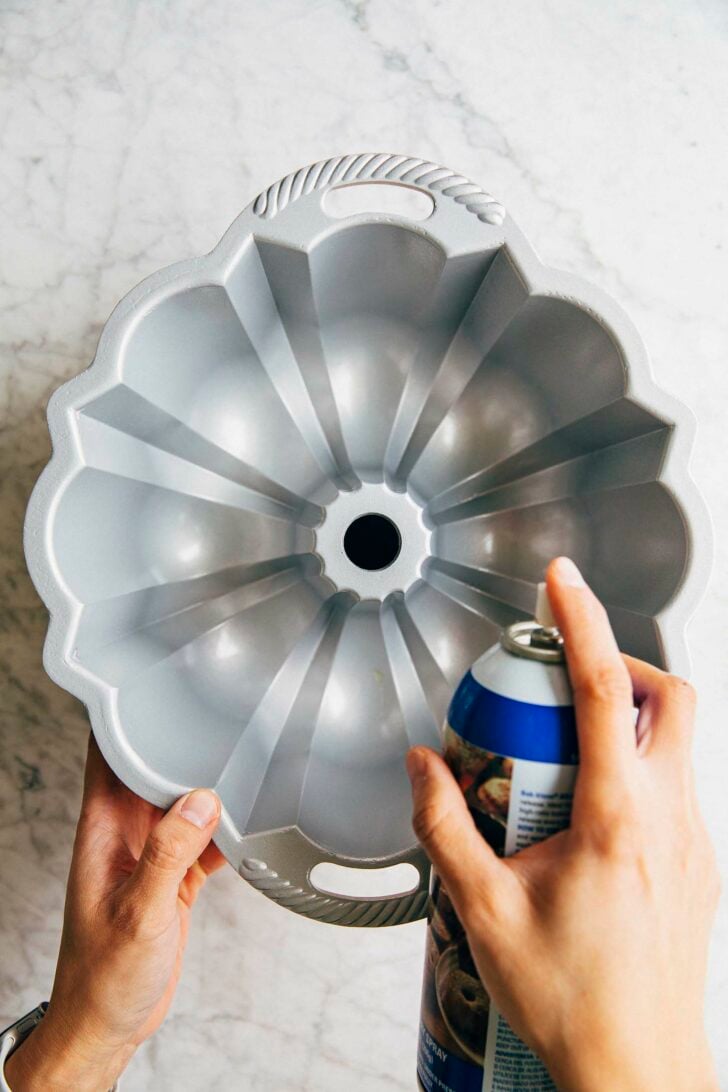
To prevent a bundt cake from getting stuck in its pan, you need to use a LOT of cooking spray. And when I say a lot, I *mean* A LOT. When done prepping the pan, you are going to be uncomfortable with the amount of cooking spray in the pan.
3. Use the right kind of cooking spray, too.
And when it comes to greasing bundt cake pans, not all cooking sprays are created equal. Butter, coconut oil, and shortening based cooking sprays don’t work as well. Stick with fats that are liquid at room temperature. Think: canola oil, vegetable oil, and so on. I personally like Bak-Klene ZT All Purpose Release Spray.

Bak-Klene ZT All Purpose Release Spray
Some folks swear by cooking sprays like Baker’s Joy or Pam for Baking. These are cooking sprays that also have flour. However, I’ve found that these sprays leave the exterior of my bundt cakes mottled and patchy-looking. But if these flour-based sprays are what has worked for you in the past, go for it! Don’t fix what ain’t broke, lol.
Others use a homemade pan release “goop”. These goops are made with equal parts melted shortening, oil, and flour. Instead of spraying the pan with cooking spray, bakers use a pastry brush to brush the goop on. I’ve tried this method in the past, but found it didn’t work any better than my cooking sprays. I’d rather skip the extra step and effort of making pan release goop and stick with my cooking spray. But again—if this is what has worked for you in the past, stick with it!
4. Only grease the pan right before filling it with batter.
Most cake recipes instruct you to grease the baking pans in the first step of the recipe. After greasing the pans, the recipe instructs you to then make the cake batter. While this method works for almost every other cake recipe, it won’t work for a bundt cake.
A good bundt cake recipe will instruct you to grease the pan right before filling it. Why? Like I said above—you will need to grease your bundt pan with a LOT of cooking spray. So much that, if the pan sits for any more than a few seconds, all that cooking spray will slide down the pan’s sides and create big pools of oil at the bottom of the pan. Not only is this gross, but it also increases the likelihood of your cake getting stuck in the pan since all that oil is no longer coating the pan’s sides.

5. Turn out the bundt cake while it’s still warm.
Many experts recommend cooling the your bundt cake for only 10 minutes before turning it out. And it’s true—a warm cake is easier to turn out than one that’s cooled completely. If you want to be EXTRA cautious, cool the cake right side up (with its bottom facing upwards) for 5 minutes. Then, invert the cake and cool it upside down (with its bottom facing downwards) for another 5.

How To Get A Stuck Bundt Cake Out of The Bundt Pan
Uh-oh. You followed my tips above but still ended up with a bundt cake that’s stuck in its pan. Don’t panic! Instead, try the following tricks below to unstick the cake:
1. First, unstick the edges of the cake with a flexible offset spatula and give it a few jiggles.
Use a flexible offset spatula (one whose blade is made out of plastic or silicone, NOT metal) and run it around the edges of the pan and its center tube.
Note that doing so only works for more “forgiving” bundt cake pan designs like the one I recommended for beginners. If you used a more elaborate pan with sharp edges and lots of nooks and crannies, you might accidentally ruin its design!
You can also (gently) shake the cake in its pan side to side a few times in all directions. Doing so helps release the surface of the cake from its pan. You can also use a wooden spoon to tap the top and sides of the inverted cake to help release it.
2. Steam the cake.
Both King Arthur Flour and The Kitchn recommend “steaming” the stuck cake out of its pan. In theory, the steam helps release and loosen the cake.
King Arthur Flour recommends filling your kitchen sink up with very warm and steaming water and setting the cake in it for 15 minutes. The Kitchn, on the other hand, recommends placing a damp, steaming hot towel on top of the pan.
I can only personally vouch for King Arthur Flour’s method (it’s the only one I’ve tried). Frankly, I’m too worried that The Kitchn‘s recommended way would make my cake soggy!
3. Freeze the cake.
If the steaming trick didn’t work, don’t worry—I still have one more trick up my sleeve.
Wait until the bundt cake has cooled completely to room temperature. Then, freeze the cake uncovered for 1 to 2 hours, then try to invert it again. In theory, freezing the cake will help release the cake from its greased sides and prevent you from damaging its design when you try and invert it.
However, don’t try this trick if you used butter, coconut oil, or shortening (which I recommended against, remember?) to grease your pan. Freezing solidifies those fats and will cause the cake to stick in the pan even more!
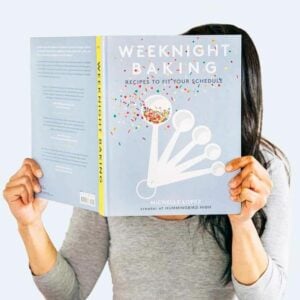
Love these expert baking tips and tricks? There’s more where that came from! Check out my cookbook, Weeknight Baking, where I share all my best baking techniques!
My Favorite Bundt Cake Recipes on Hummingbird High
Now that you know all my secrets, it’s time to bake! Here’s a round-up of the most popular bundt cake recipes on my site:
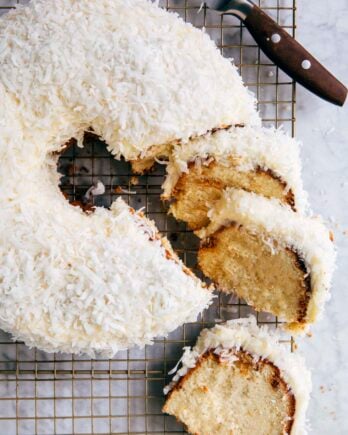
Tom Cruise Coconut Bundt Cake (Copycat Doan’s Bakery Recipe)
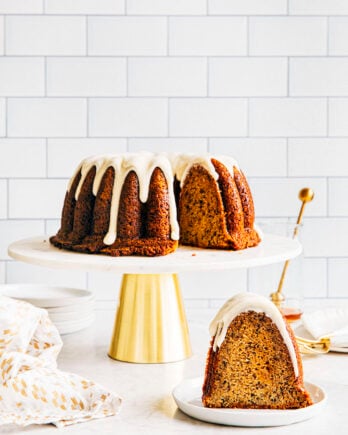
My Best Banana Bundt Cake Recipe
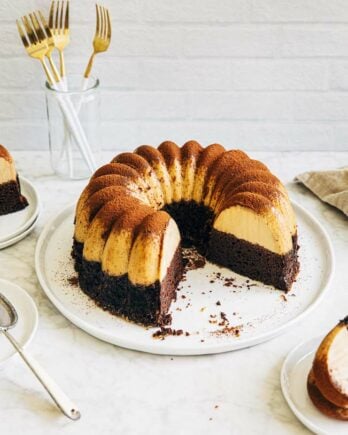
Chocoflan Recipe
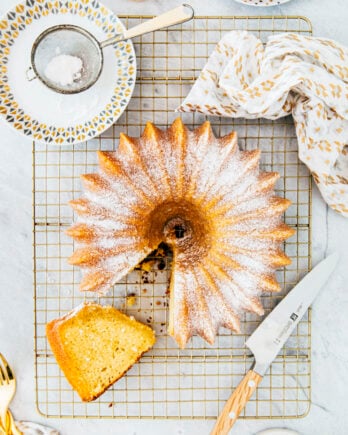
Kentucky Bourbon Butter Cake Recipe
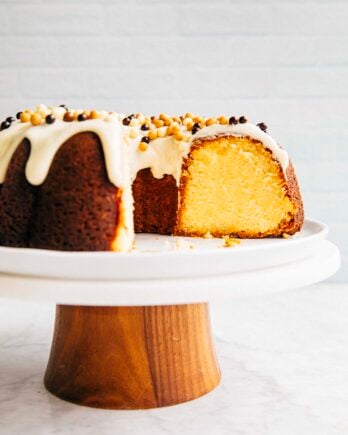
Banana Pudding Bundt Cake From Scratch (No Cake Mix!)
buy the book
Weeknight Baking:
Recipes to Fit your Schedule
Over the past several years of running Hummingbird High, I kept a crucial aspect of my life hidden from my readers: I had a full-time, extremely demanding job in the tech world. In my debut cookbook, Weeknight Baking, I finally reveal the secrets to baking delicious desserts on a tight schedule.

Ive been contemplating this recipe and finally made it on mother day. W O W. First of all I appreciate all the hints and tips you gave us especially the spray used RIGHT before you pour in the batter to the bunt pan. It did take 80 minutes. I did not use a pan underneath. When the smell of coconut was permeating the kitchen I was like a little kid on christmas eve!!!!
I purchased the spray you recommended it was MAGIC!!
Time came to insert to see if it was done! It was ready. The crust was decadent I kept picking it. 10 minutes timer was up and I had to flip the cake while warm. I turned it over BAM PERFECTO!!! nothing stuck to the pan, a miracle! I wish I wouldnt have iced it. Its decadent by itself. Its a fantastic pound cake! thank you for sharing with us.